Between March and April, nearly 500 internal communications professionals completed IoIC’s (Institute of Internal Communication) Covid-19 survey. The survey was created to determine how the pandemic has positively impacted brand presence and reputation.
To summarise, despite the challenges presented by Covid-19, internal communicators are confident that their work in recent weeks has improved both their presence and reputation.
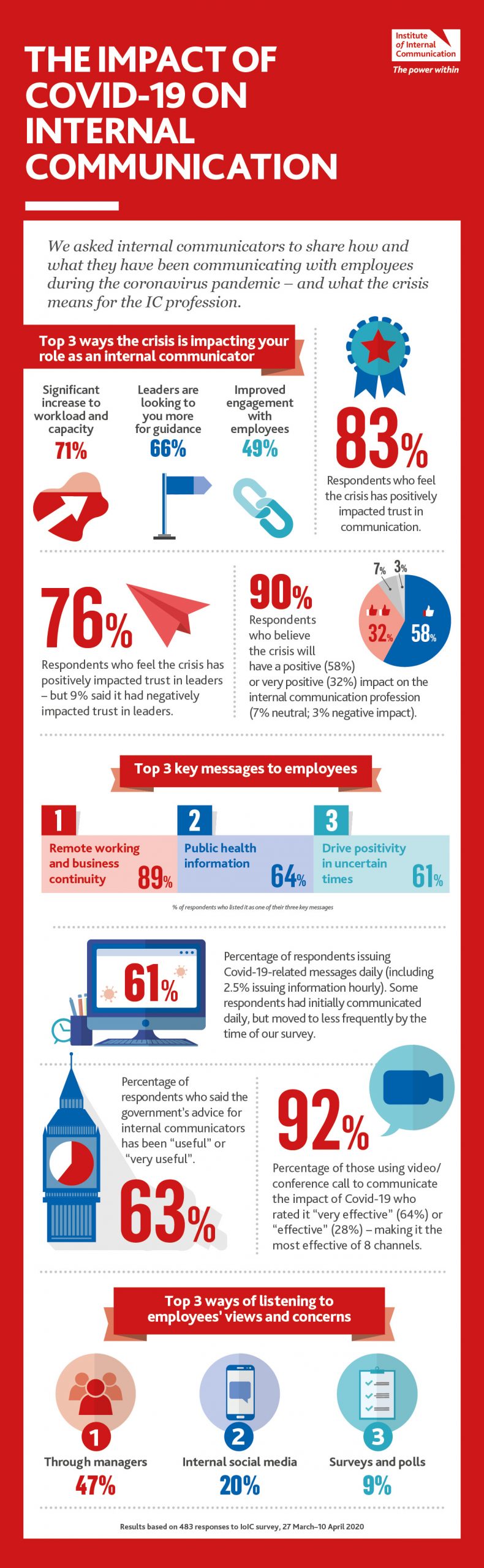
It’s interesting that respondents believe their response to the crisis is likely to benefit their long-term credibility, with 90% believing the situation will have a “very positive” (32%) or “positive” (58%) impact on the internal communications profession.
There is an increase in trust
According to the survey, 83% are seeing a positive impact on trust in communication.
Internal communicators say their communication around Covid-19 is having a positive influence on employees’ trust in both communication (83%) and leaders (76%). The expected impact on trust in line managers is less telling, with only 53% believing it will improve (42% were neutral). However, it should be noted that managers are, by far, the primary source for respondents to gauge the views and concerns of employees, with 47% relying on them; second is internal social media, used as a primary source by 20% of internal communications practitioners.
There is greater visibility for Internal Communications
According to the survey, 66% of respondents believe that leaders are looking to them for more guidance as a result of the crisis.
The situation is also positively affecting internal communications practitioners’ roles. While the added workload during the crisis is the main impact (71% of practitioners registered a change), two-thirds say leaders are looking to internal communications teams more for guidance. 50% noted improved engagement with colleagues, 44% say they have learnings they can take into future roles, and 43% have developed crisis management skills.
Interestingly, one respondent from the survey said “So many non-IC people have become aware of the importance of our role, some didn’t even know what we did four weeks ago. So, it is critical that we make sure everyone knows who kept the news flowing, the troops informed and the morale buoyant.”
One of the top challenges: cutting through the noise
Almost one-third of respondents responded that “cutting through communication noise” is their biggest challenge in communicating Covid-19 (twice as many who cited “consistency of message”, which came out as the second biggest challenge).
Several respondents stated that a key challenge was the speed that information is changing.
One respondent commented: “Decisions and messaging we agree on one day are being turned on their head within 24-hours. We’re in the travel industry and the situation is continually evolving.”
Another said it has been critical to getting the balance right – “not overwhelming with too much info, which can cause stress, but making sure the seriousness of the situation is clear”.
The impact on mental health
For many respondents, the challenges and personal concerns stretch beyond communication. A quarter of respondents are concerned about lost income and 14% about the possible closure of their organisations.
Many referenced the impact on mental wellbeing, caused largely by the increased workload to individuals and on the whole team – as a result of the loss of colleagues – and working from home with a young family. There are other factors causing anxieties, including long-term isolation, concern for their own health or that of family members, and delays to business-as-usual projects as crisis comms takes over.
One respondent summed up the stress as “putting out a ridiculous amount of comms while working at home with two small kids” and others raised concerns about sustaining the high volume of work into the foreseeable future.
The core messages
By some way, the three main messages communicated to employees are:
- remote working and business continuity
- public health information
- driving positivity in uncertain times.
Personal health is believed to be one of the employees’ greatest concern.
Use and effectiveness of channels: email and video calls
According to the survey, 88% are using video and/or conference calls – of which 92% believed that this channel was effective.
Unsurprisingly, email is the most used channel (for 99% of respondents), with 46% saying it is “very effective” and another 36% saying it is “effective”.
While a slightly smaller proportion have been using video and/or conference calls, 92% of those who are using it say it is either “very effective” (64%) or “effective” (28%).
Around a quarter of communicators have not been using social media platforms to talk about the crisis, and only 62% of those who are using these channels say that they are either “effective” or “very effective”.
At the time of the IoIC survey, 56% of respondents were still communicating daily, with a further handful communicating hourly. Additionally, other respondents indicated they had previously been sharing information daily, but over time this had become less frequent.
Internal and external comms also appear to be working closely together, with almost two-thirds (64%) saying the messaging was very well aligned, and only 2% saying it was not at all.
The sharing of best practice
Respondents indicate they have been getting value from webinars and sites sharing tips and guidance, and are keen to hear more from peers about what is working well in their organisations.
“We should capture the great practice happening now,” said one respondent. “This is hopefully a once in a generation event, and we should pass this experience onto the next generation of communicators.”
Some are looking ahead to life and work after the pandemic.
“I’m taking great comfort in the fact everyone is in the same boat – just maybe navigating choppy waters at different times. Planning for a life after this is key because it will pass.”
“I’m really interested to know how IC professionals expect culture and engagement to be different post-Covid.”
More than half of the 483 respondents were from the private sector – including finance, construction, healthcare, energy/utilities, technology and travel. One-fifth were from the public sector, eight per cent were from charities and eight per cent were from agencies.