

Defining High Performing Activities
There are many ways that high achievers differ to the rest of the world. They set rules for themselves in order to ensure that they don’t lose productivity or reduce their efficiency in the day. Here are some of the rules they try to follow:
Don’t Make A Habit Of Checking Your Phone First
Did you know – 46% of Americans – and 66% of millennials – confess to checking their phone before getting out of bed each morning, and a third admit to waking up and checking their phones during the night.
It’s an easy habit to get into and often there is a FOMO (fear of missing out), but if you’ve set goals for yourself, checking your phone can derail your day. High performers and successful people usually go to bed with a clear plan of action for the next day. When they get up they are focused on executing that plan – not getting involved in what other people are posting on social media or what emails have been put into their inbox.
No Unscheduled Phone Calls
The moment we decide to stop what we’re doing to take an incoming call we become distracted from our current activity. Did you know that a simple distraction can affect your concentration for up to 20 minutes at a time! A great activity would be to measure how many distractions you get a day from phone calls and see how many minutes (or hours) a day are being wasted.
When we’re doing our high value work, we should not answer incoming phone calls, check email or allow any other distractions.
In fact, we’d recommend that unless you are expecting a ‘must answer’ call, either put your phone on silent, hide it in your bag or put it in another room. We try to store our calls and then respond to them at certain times of the day. This keep us in control of our time and attention.
Only Check Emails At Pre-Determined Times
Email can be one of the biggest time-drains known to man. To help you, we’d recommend the following strategy:
Set 2 or 3 times each day to check and respond to emails. We usually set 12pm and 4pm but your key times might differ depending on your life and needs. The lunchtime check gives you the opportunity to be productive before the emails come in, yet still allows you time to respond same-day if need be, while 4pm does the same for the afternoon.
To help manage customer’s expectations, you can set up a simple auto-reply message that informs people of the times that you check emails that sets the expectation for when they can expect a reply.
Break Up Your Time
We use a simple method of breaking up our work time into smaller, more manageable chunks.
We set 15 minute windows of work, once we’ve completed 2, we are entitled to a 5 minute break, after we’ve completed 8 windows of work, we schedule a longer break of 30-minutes. For each 15-minutes, we allocate a task to be completed and schedule larger windows of time for bigger tasks.
Limit Distractions
One of our biggest learnings is to turn off all notifications on our phone and computer. This is easy to do within the settings and stops us being distracted by unnecessary pop ups or being advised of every WhatsApp message, email etc. This may sounds simple but is an excellent way or reducing time spent distracted by outside influences. If we’re focused on a task and being productive, we don’t need to know that someone commented on our last social media post.
Don’t forget: flow follows focus. To achieve the most and work at peak performance, we need to be able to concentrate on the job in hand!
Have A Plan (and don’t deviate)
To achieve your goals you need to take intentional action. For example, if you wish to lose weight you need to reduce your calorie intake and exercise more. This doesn’t happen by accident, it requires you to put together a plan – this may involve how you plan your meals and grocery buying, committing to joining a gym or just agreeing to walk more and travel in the car less. However, even the best plans are of no use if you don’t follow them.
Cognitive researcher Antonio Damasio found that 95% of our decisions are made based on feelings, not logic. This explains why 70% of people who set goals fail to reach them.
To be effective with time management and achieve your goals you need to have a clear course of action. Like a SatNav – this should clearly show the steps you need to go from A to B. Having the SatNav is just the first step, despite our feelings, we need to walk the path and stick to the plan – no matter how we are feeling or what our circumstances are on a specific day.
Duplicating Time Activities
It’s been fashionable for people to talk about how they ‘multi-task’, however, you need to think about which activities you double-up on.
Have a think and see where in your life you can double-up on activities, without affecting the quality of the output and providing you with multiple benefits for your health, productivity, and time. The key is to get multiple results for a single unit of time. It is not about juggling too many tasks, but looking for opportunities where you can genuinely create a duplicate result, in a single amount of time.
For example:
• Listening to audio programmes whilst in the car, in the gym, walking, etc.
• Taking calls in the car (with a hands-free kit of course!).
• Checking your social media accounts while having a haircut or at the beauticians.
• Getting the train where possible so that you can work on the go.
• Bringing in outside help such as a gardener, cleaner, cook, ironer etc.
If used properly, It is one of the best ways to get more done in less time; and get the most out of every minute of every day.
Understand (and Employ) The Quadrant Of Importance
Busy and productive are not the same things and we shouldn’t treat them as if they are. In his book, 7 Habits of Highly Effective People, Dr. Stephen Covey shares the following diagram that should be a blue print for life.
Can you see where there is wasted time? Boxes 1 and 2 are where our critical tasks are, whereas boxes 3 and 4 could be construed as wasted, or should be avoided – or delegated!
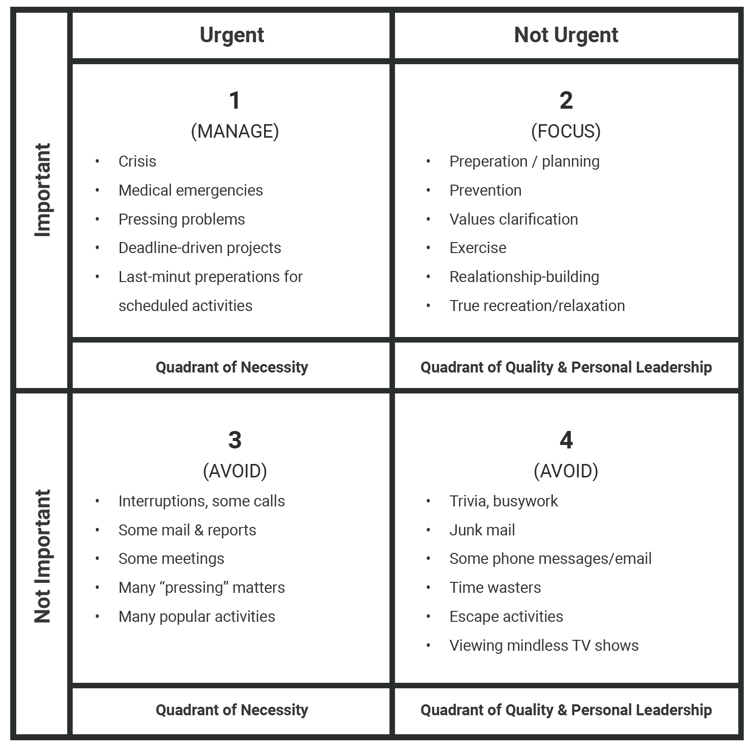
To summarise:
Understanding and focusing on high performance activities will revolutionise your business and your life.


