
What is Marketing?
For some, marketing is a dark art – that magical skill that through smoke and mirrors automatically generates customers and sales for your business. However, this could not be further from the truth. We can debunk that myth and confirm that marketing is anything but rocket science and something you can easily do yourself for your own business.
The definition of marketing is as follows (according to the Chartered Institute of Marketing (CIM)):
Identifying something that people or businesses want and are prepared to pay for, or a problem that they would like solved (it could be an easy way to make a cup of tea, it could be getting the latest music). Developing a product or service that meets that need and then promoting it so that the audience is aware of its existence. Working out the details and making sure you’re charging the right price for the product or service. If the price is too low, you won’t make any money, if it’s too high, people won’t buy it
It’s that simple!
What is the Marketing Mix ?
If you already have or are starting your own business, the chances are you have a pretty good idea of the product or service you are able to offer.
The challenge you face now is getting potential customers to know about the product/s you offer and getting them to pay for them. For many, marketing is all about getting the word out there, but in fact, you can waste a great deal of time and money trying to promote your business. For marketing to work and be truly effective, you need to understand the marketing mix.
As a business, your marketing mix is the combination of elements that play a role in promoting and delivering your products and services to your customers. It’s about getting your product or service out to the right places, at the right times, in front of the right people for the right price.
Elements of the Marketing Mix
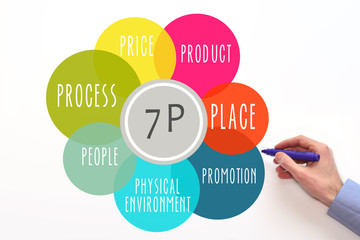
Originally, their were 4 Ps – product, price, place and promotion, but as marketing has evolved three more Ps have been added – people, process and physical evidence.
Product – These are the products or services you offer to your customer, how they look, what they do, how they differ from your competition, and what benefits they provide.
Price – This is the cost of your products or services – you need to ensure that your products are competitively priced so that you can make a profit, but not be charging more than your customers are prepared to pay.
Place (Also referred to as Distribution) –This is the marketplace (online or physical) where your business sells its products or services and how it gets those products or services to your end customers.
Promotion – These are the tools and channels you use to communicate the features and benefits of your products or services to your target customers.
People – refers to the level of customer service you offer and how the expertise and skills of the people who work for you set you apart from your competition.
Physical Evidence – is just tangible proof of what you offer and that you exist. This could be in the form of a website or social media presence, customer feedback and testimonials and / or ratings on industry specific sites.
Process – is the procedures, mechanisms and flow of activities by which your service is delivered.
The marketing mix can sometimes seem like a difficult thing to apply to your business. However, it will encourage you to research and plan your marketing strategy for maximum effect. Going through each ‘P’ in turn allows you to focus on the different areas of your home-based / craft business. For each, you want to try to answer the following questions:
Product: Your products or services are your livelihood. When considering your products, it’s worth paying special attention to the benefits your products offer and who are the target audience who would most appreciate them. This means developing a unique selling proposition (USP) and defining who your target market are. For example, if you sell mortgages, what benefits (uniqueness, quality, style) will your customers gain and who will be buying them (first-time buyers, property investors, remortgagers).
Price: Pricing needs to take into account what your customers can afford to pay versus the need to calculate the value of what you offer, and what it costs you in materials, time and overheads (e.g. electricity, premises) to produce it. You have to ensure what your charging is in line with your competition and provides a fair exchange for what you offer and the money received. You don’t want to undercharge, but neither do you want to ask people to pay more than what your product is worth. You may also wish to consider what ‘extras’ you can offer, which will add value for your customers
Place: This doesn’t need to be a ‘bricks and mortar’ shop, but the location your audience can find and order your goods. You have to consider your products, market, and price, where will your customers expect to find them? Would they expect to see you on specific trade site, on Amazon, in retailers or on social media etc.? Knowing where your audience expect to see you, will ensure that you maximise your reach and the opportunities to be seen by your customers.
Promotion: This is where you put all the information you’ve gathered to work. You know your product, who can benefit from it, the best price to sell it at, and where to sell it. Now, you have to get customers to your “store”. Promotion is all about knowing where your customers can be found, how to ensure they see and check out your product and choose the best method (or channel) for delivering that message. These could be online channels such as social media, craft selling websites and blog posts or offline such as advertising in local publications, promotional leaflets and word of mouth. The most effective marketing is focused on message and location. Think about your audience and what they look at, where they visit and what would appeal to them to want to buy from you. It is estimated that it can take up to 9 different views or touchpoints, before you turn a prospective customer into an actual customer.
People: All your other Ps could be working well, but if your customer service systems fall short, it won’t matter how good the other Ps are. Today, more than ever your customers have a choice about who they do business with, and they prefer businesses that know their stuff, are willing to help, meet their agreed deadlines and are responsive. Social media can make this easier, because these platforms support the building of trust and rapport with consumers.
Physical Evidence: It’s definitely worth considering providing proof of the quality of your products or services. This could be via good, quality photographs, testimonials and online reviews. Having a good social media presence and a website presence will help provide reassurance to your customers as you have an official public ‘face’. People buy from people they trust – so it’s a good idea to include your picture, some information on what you offer and the benefits. Note: videos are great content and very good for improving your position online in search rankings.
Process: Is a set of activities that you undertake that results in the delivery of the product or service benefits. This could be the order of tasks that an employee undertakes as a part of their job. It could be the unique way you as a business demonstrate value through delivery. For example, a restaurant manager is responsible for a variety of processes – from monitoring their team, to managing customers from initial greeting, to seating, to service to food quality and payment and encouraging repeat visits.
To summarise:
Marketing is not rocket science and anyone can market their business. The key thing to remember is the 7 Ps of the marketing mix. By taking time to evaluate each one you can begin the process of attracting the right customers with the right offering at the right price.


